


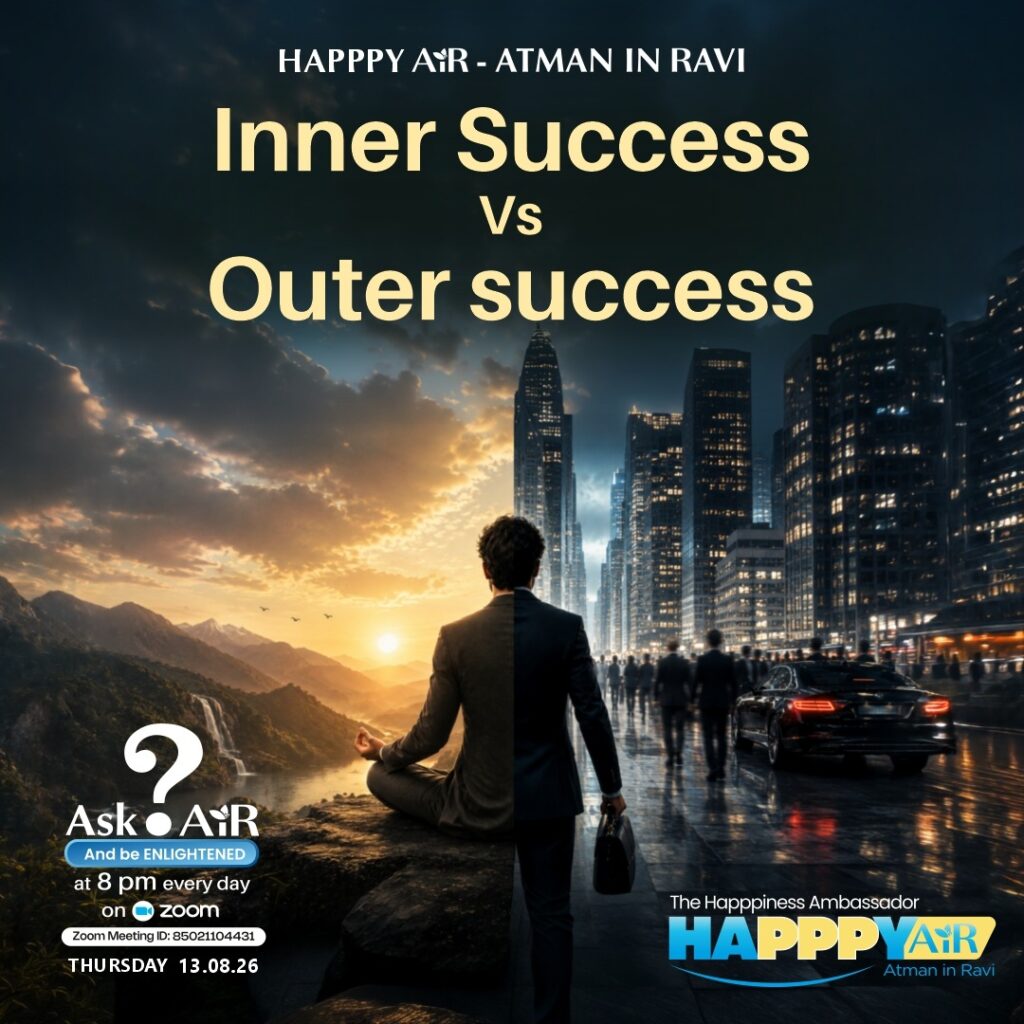
The conversation began with a simple yet profound question: What is success? We often define success through the outer world — money, position, power, recognition, possessions and achievements. We measure ourselves by what we have accomplished and how others perceive us. But is that really success?
AiR’s famous statement, “Success is NOT Happpiness, Happpiness is Success,” offers a powerful shift in perspective. Outer success may bring pleasure, recognition and temporary satisfaction, but these are inherently unstable. The outward journey is a continuous swing between pleasure and pain, gain and loss, praise and criticism, success and failure. What we achieve today can become the source of anxiety tomorrow because the outer world is constantly changing.
The inward journey is fundamentally different. It is a journey of self-discovery, awareness and inner transformation. As we turn inward, we begin to understand that lasting happpiness cannot be created by accumulating more from the outside. It emerges when we discover everlasting peace, divine love and eternal bliss.
There is a beautiful paradox here: The inner journey is the only way to success and there is no real success in the outer world. The more we chase the outer world, the more we remain trapped in its cycle of pleasure and pain. The only true success is the attainment of Moksha, which is liberation from triple sufferings.
S equals S: Success is SIP (Supreme Immortal Power) The only true journey is inward, and the only true success is the discovery of the Self, culminating in Moksha. Everything else is merely the outward pursuit towards failure!
TODD: Trust. Obey. Don’t Disobey.
Finding a Guru is a blessing. But simply having a Guru is not enough. The real transformation begins with TODD — Trust. Obey. Don’t Disobey. Wisdom changes our life only when it moves from our ears into our actions.
One of the deepest spiritual lessons I learned came from the comedy film Munna Bhai M.B.B.S. Circuit’s famous dialogue.
“Bhai ne bola karne ka, matlab karne ka.”
(“If Bhai has said to do it, then just do it.”)
It may sound humorous, but it carries a profound spiritual truth. Imagine if we cultivated the same attitude toward every instruction from an enlightened Guru. Not blind faith, but complete trust born out of conviction. No arguments. No selective listening. No convenient interpretation. Just sincere practice.
Yesterday, AiR repeatedly shared a subtle yet powerful insight:
“Instead of listening to what the Guru is saying, we listen to what we think the Guru is saying.”
That one sentence explains why many seekers remain informed but not transformed. We unconsciously filter the Guru’s words through our beliefs, assumptions, and conditioning. In doing so, the original message slowly changes.
Perhaps this is why there is often a gap between what the Buddha taught and what later traditions came to emphasize, or between what Jesus spoke and what later interpretations sometimes present. Over generations, the human mind adds its own meanings, explanations, and preferences. The pure teaching can become layered with interpretation.
The gap between knowledge and realization is often the gap between hearing and obeying. ToDd reminds us that spiritual progress is not measured by how many teachings we collect, but by how faithfully we live them.
Here’s a question to reflect on: When your Guru speaks, are you truly listening to the Guru… or to your own interpretation of the Guru’s words?
Why is Advaita Vedanta the most significant philosophy for life ?